
thinking less
If a NYT bestselling author can admit that she’s finding flaws in an early draft of her tenth book and leaving it up to her editor, why the f*ck am I so hard on myself?

Hi besties,
I’m setting out to think less. Let me explain —
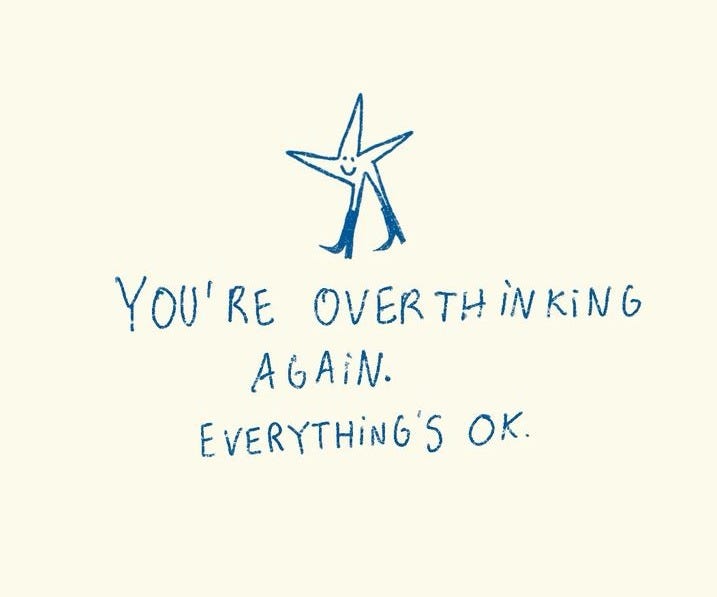
I read an article on Substack this week that hit me hard. It was about toxic self-awareness and the idea that some people become so aware of everything they do, say, and feel, that they end up paralyzed by it.

I’ve always known I’m highly sensitive, which is great for being a writer or an artist of any kind. It’s a superpower, really, to see the world in an extraordinarily empathetic way.
But it’s also a burden.
Last week, I listened to Haley Hoffman Smith’s Big Conversations podcast with Sarah Levy, author of Drinking Games. They had a vulnerable conversation about being creatives and learning to shed self-criticism. Sarah said something along the lines of, “If you say you’re self aware but it’s only negative things about yourself, that’s just repackaged self-hatred.” Woof.
Between that and the article, it felt like the universe wanted me to receive this message loud and clear.
Being highly sensitive, deeply self-aware and trying to pursue a fragile, creative dream — while facing rejection, silence, and uncertainty — is a toxic cocktail. And I’m drinking it.

The trap of “being self-aware”
In Karun Pal’s article, he says:
That’s the cruelty of toxic self-awareness: you become so conscious of everything that could go wrong that you stop yourself from everything that could go right.
Ironically, highly sensitive people fall into this trap the most. Not because they’re weak, but because they feel too much and think too deeply in a world that rewards emotional numbness.
If you’re nodding along in agreement, like, yes I do feel too much and I do think too deeply about everything, then you’re like me. Pal goes on to say:
No one checks on the “self-aware” one. No one comforts the “emotionally intelligent” one. No one asks if the “deep thinker” is tired of their own mind.
And so they suffer quietly. Not in public. Not loudly. Not dramatically. But silently in the quiet corners of their own mind.
Toxic self-awareness is invisible because it doesn’t look like struggle. It looks like maturity. But inside, you’re drowning in mental noise. Wishing someone would see it. Wishing someone would ask the right questions. Wishing someone would tell you, “You don’t have to carry yourself so perfectly.”
Because the truth is: You need to feel safe enough to stop being so aware all the time. You need someone who lets you be imperfect. You need a life where you can finally stop monitoring yourself. A life where you can be just you.

So what do we do about it?
I don’t have the answers. I’m very much in the middle of this.
Honestly, this entire substack is a vulnerable overshare about my mental state lately. You signed up for updates about my fantasy book, and instead you’ve been getting…this.
Here’s what’s in my toolbox:
Journaling: I know this is so fucking cliche, but idfc. I need to journal every day for my mental health. Ideally three pages (a la The Artist’s Way). Even if I’m repeating the same affirmation over and over, I need to get it out of my head and onto the page. Once it’s written down, it’s like my brain can finally let it go. When I look back at old entries, I realize how many things I thought were massive…that weren’t. Perspective is everything.
Meditation: I use To Be Magnetic (TBM), and it’s probably my most effective tool besides journaling. They just added a 7 Day Nervous System Reset, with all meditations under 10 minutes, though I find the Feeling Worthy deep imagining (DI) to be the most helpful. These meditations get you into a hypnotic state to reprogram your neural pathways and subconscious.
Movement/Sunlight: Getting outside, walking, feeling fresh air on my face — boyyyy is that effective. Sounds obvious but it really is a game-changer.
Talking to people: Or oversharing on substack :) I am so grateful for friends I can be honest with. When I say my thoughts out loud, they don’t sound nearly as convincing. My inner voice is brutal, but my friends are not. And that means so much.

Thinking less and taking action
After reading Pal’s article, my immediate reaction was: okay, I’m going to think less then. I’m not suggesting numbing out, not suggesting shutting down my sensitivity. That part of me is a gift.
But I’m going to actively override the overthinking, self-hating voice in my head. One question I find helpful to ask myself is:
Would a mediocre white man overthink this? Would he spiral? Doubt himself? Hold himself back until everything was perfect?
No. He would simply decide he’s qualified and go for it.
What that looked like this week
Posting on social media
In case you haven’t noticed, I’ve been posting twice a day on Instagram since that writers’ conference in Boston. Growth has been slow, but steady. I gained about 30 new followers and went from 5k views to 80k on my page. Most importantly, I’m learning what hooks work, what doesn’t, who’s actually engaging.
Before, I was afraid people would think I’m cringe for posting about my fantasy book that doesn’t even have an agent. Because that’s the core wound for me. Not fear of being seen. But fear of being seen trying, not having “made it” yet. A book that doesn’t have an agent or publisher? Embarrassing! My inner voice said.
Querying
I sent five aligned queries this week. Even though I’m still line editing my revised manuscript.
In order to stop being stuck, I need to take action. I keep playing scared, afraid because my manuscript isn’t “perfect.” I let all the voices on the internet (authors, editors, agents, etc.) scare me into believing that my manuscript and I need to be perfect before I can take a step.
But I am good enough. Besides, I could believe my manuscript isn’t ready forever, always finding flaws in it that keep me from taking aligned actions.
Victoria Aveyard, one of my favorite fantasy authors, recently shared that she was finishing the second draft of her adult fantasy sequel, Tempest 2 (the title is under wraps still). She vulnerably said that the manuscript wasn’t in that great of shape, that she needed one more developmental edit, but that she was letting it go into the trusted hands of her editor.
If a NYT bestselling author can admit that she’s finding flaws in an early draft of her tenth book and leaving it up to her editor, why the fuck am I so hard on myself?
Pitching brands
Channeling that same energy, I pulled out an old spreadsheet of brand contacts and started cold-emailing. Before I quit my job and left for Italy, I went through the sponsor database and made a list of aligned brands for my future author career.
I cold-emailed a few brands yesterday. I didn’t ask for anything. I just introduced myself, shared my story, and opened the door to build a relationship as I grow my author audience. Old, overthinking me would have waited until I felt ready, until the book had an agent or I had “enough” followers.
Jobs (the hard part)
This is where the inner critic is the loudest. My inner self-aware “bitch” comes in with shame and pressure and “what did you do?” Leaving a stable job to pursue something uncertain has a way of bringing all your worst thoughts to the surface.
I’ve applied to probably one hundred remote jobs, and have only had one interview (that wasn’t even with a human but with AI), which rejected me because I didn’t “think like a computer.” My self-esteem has been in the barrel as I navigate opening a new income portal.
When it gets really bad, I ask myself: would the people who love me think this about me? Would my best friends say these things? My sister? No.
Where I’m landing (for now)
Maybe “thinking less” doesn’t mean becoming numb. I think it means choosing which thoughts deserve your attention. I’m trying to listen a little less to the voice that hates me and a little more to the one that wants me to live vibrantly.
Another powerful quote I saw on Substack this week hit the nail on the head, from Layla Shaikley’s Self-sabotage starts as self-protection:
Many people lack a well-regulated brain. And without a well-regulated brain, you will not have an extraordinary life. Being overwhelmed, mean, chronically overthinking, and emotionally volatile are costing you more than you realize.
Because those feelings get in the way of goals — and your brain doesn’t care about your goals. It cares about your survival. The life you say you want — the promotion, the business, the version of yourself that posts publicly and charges more and leads boldly — registers in your nervous system as a threat.
Questions I’m asking myself when I journal this week:
What would I do today if I trusted myself 10% more? What am I overthinking? What’s the simplest possible action I can take instead?
Which thoughts are useful and which ones are just loud?
If I stopped trying to be perfect, what would I finally let myself do? What feels unsafe about that? Whose voice does the fear actually sound like? Do I agree with it?
If you made it this far, thank you for overthinking and being vulnerable with me!!
Until next time,
with love and magic,
Bri — your author bestie